Showing posts with label movies. Show all posts

Saturday, August 23, 2014

Movies About or Around Europe: "The Lives of Others"/"Das Leben Der Anderen"

Perhaps "The Lives of Others" should be a mandatory double feature with "Goodbye Lenin", which I previously reviewed. http://jensroadtoeurope.blogspot.kr/2014/08/movies-about-or-around-europe-goodbye.html While "Goodbye Lenin" shows a lighter side of the DDR, a life in transition as the wall comes down, "The Lives of Others" shows a country where ordinary people's lives can be destroyed forever by the Stasi, East Germany's state police. Perhaps you have already seen the film, since it has won many awards, including the Academy Award for Best Foreign Language Film, and was pretty much universally acclaimed when it came out. If you haven't seen it, however, here's a review of the film which comes with my highest recommendation.

"The Lives of Others" is truly one of the best films I've seen in a long time. 
The main characters are a member of the Stasi, Hauptmann (Captain) Gerd Wiesler, and the artist couple Georg and Christa Maria, whom  he's asked to run surveillance on by his friend and superior in the Stasi. The surveillance turns out to be a set-up on behalf of a high-ranking party official to get Georg out of the picture so that he can gain full access to Christa Maria, whom he's already been pressuring into a sexual relationship.Whether Georg is guilty or not isn't the point. Wiesler is charged with finding something.

What the upper officials don't account for, however, is Captain Wiesler's dedication not just to the party, but to ideas of right and wrong. He's disenchanted from the first by his friend's ambition to get ahead, regardless of the truth. He also appears to be immediately quite personally attracted to Christa Maria, which leads him to look out for her and intervene in her life. At one point in the story he uses information he's discovered about her personality through surveillance to convince her to return to Georg, rather than meeting the party official who's been sexually pressuring her. After his successful intervention, and the resulting happiness of the couple, Wiesler's interest in their lives only grows, and he is drawn deeper into a world of shades of gray and farther from his purpose as a Stasi official.

Captain Wiesler begins to become less strict in carrying out his duties in general, as he's exposed to Georg's private life.
Wiesler is also particularly sensitive to beauty, as in one scene where he appears to be transported by Georg's piano-playing heard through his surveillance headphones. The film's director, Florian Henckel von Donnersmarck, told the New York Times that his initial inspiration for the film was the idea of just such a scene where a Stasi officer would overhear a supposed enemy of the state making music and be moved by it. In the film, Wiesel is also shown "borrowing" and quite enjoying one of Georg's books, a work by Brecht. These artistic connections between Wiesel and Georg create a thread of hope and light throughout the film, that creation and beauty may really trump forces of destruction.

Georg plays a piano song to release his emotions with unimagined effects on Captain Wiesel, who listens in secret. 
This was an exceedingly moving film, and I am sure I will watch it again at some point. The characters are well-drawn and fully human. The plot is involving but not at all rushed. The themes are universal and relevant, and surveillance is certainly not a relic of the past. I think this film is also a great introduction to the dark side of the DDR, though some critics have pointed out that the situation portrayed in the film perhaps would have been impossible, since Stasi officials were generally watched by other Stasi officials or operated in teams. Whether or not it is strictly historically accurate, however, it is true to human nature while also being forgiving of our collective weaknesses and hopeful about our future. This combination is rarer than it should be. I recommend seeing this movie as soon as possible!

*On one final note - I've reached 70 days of consecutive French and German study as of today. I'm happy to say, also, that in the 2 weeks or so since my last German film viewing, I've noticed a large increase in the amount of German which I can understand without the subtitles. I'm understanding whole sentences at times, and I'm getting more words in other sentences. It's really quite encouraging!

Saturday, August 9, 2014

Movies About or Around Europe: "Goodbye Lenin"

"Goodbye Lenin" is a funny and moving portrait of one son's efforts to keep his mother from finding out about the collapse of East Germany in order to save her from a life-threatening shock, starring  as Alex and  as his mother. 


We meet the family in Alex's childhood, as his father disappears from the family life into West Germany. After losing her husband, Alex's mother, Christiane, devotes her entire life to socialism, becoming active in community life and "marrying the party." As protests begin to spring up in 1989, however, Christiane witnesses Alex participating in one, and suffers a heart attack. She then lapses into a coma for eight months, the Wall comes down, and the worldview she devoted herself to collapses with it. When she wakes up, the doctor says another shock could kill her, so Alex decides he and his sister should bring her home and create the past in the apartment. This starts out as a fairly simple matter of redecorating, but becomes more and more complicated as the world continues to change outside the apartment. Eventually, in his love for his mother, Alex goes so far as to help make fake news reports to explain away phenomena such as a Coca Cola advertisement being hung on a nearby building or the presence of West Germans in their neighborhood.

The movie's fake newscasts are some of the most interesting and inventive parts of the movie, as Alex begins to create an alternate history of his country, with the help of a film-savvy friend.

While Christiane is kept in the dark, the viewer is treated to a movie about a country and its people in transition - some are overjoyed and excited, others, mainly the older people, are worried or angry about unemployment and the loss of old routines. Here are, in fact, two links to fairly recent articles about dissatisfied East German citizens - one is an opinion piece in the Guardian, the other a feature in Der Spiegel:  http://www.theguardian.com/commentisfree/2009/nov/08/1989-berlin-wall  http://www.spiegel.de/international/germany/homesick-for-a-dictatorship-majority-of-eastern-germans-feel-life-better-under-communism-a-634122.html

I had a very limited knowledge of East Germany, or in German, the Deutsche Demokratische Republik, before watching this film, but the movie made me curious to learn more. It's amazing to think that such a huge transition happened within my lifetime, and within the lifetimes of Germans who are the same age as me. Since I currently live in a divided country, it's of particular interest, though the gulf between North and South Korea is certainly much wider than that between the two Germanys.

Christiane is perplexed as West Germans move into her apartment complex.

I highly recommend this film both as an introduction to this interesting time in German history and as a human drama. The acting is good, the story inventive and creative. It is the kind of movie that makes you think about what you would do in a similar situation and puts you in the shoes of someone from a different culture and time. It's also a great family film, as long as you don't mind some brief, non-sexual, male nudity.

The film made me curious to visit some sites in Germany which might help me learn more about this historical period. Here are some places I might try:
http://www.ddr-museum.de/en  (A museum in Berlin dedicated to the history of the DDR)
http://www.museenfuergeschichte.de/de/7/Zeitgeschichtliches-Forum-Leipzig.html?mid=20  (another museum on the DDR, located in the former East Germany. You'll have to translate this page if you don't read German!)
http://coldwarsites.net/country/germany  (A page which links to a variety of sites within Germany)

Finally, here are some photos taken in the last days of the DDR and an interview with the photographer:
http://www.dw.de/photographer-captures-colors-of-gdr-life/a-16864700

Monday, July 21, 2014

Movies About or Around Europe: "Downfall" ("Der Untergang")

Ever since I was about 8 or 9 years old I've been reading about the Holocaust and Hitler's Germany. I don't know why. I started with your standard children's books on the topic - "The Hiding Place", maybe "The Diary of Anne Frank", but soon I was reading "Night" by Elie Wiesel and other, darker books documenting Nazi atrocities. I watched a lot of movies on the topic too. Some of the first foreign films I watched were things like "Europa, Europa" that dealt with Nazi Germany. I've always felt a bit uncomfortable with my fascination with the Holocaust and the Third Reich, because it is a sort of fascination, and to be fascinated by something seems to imply a lack of disgust, or a lack of reverence for those who suffered. It seems lurid to me, a species of people craning their necks to get a look at a car accident only worse. Yet it is part of me. I deplore the Holocaust, and I deplore fascism and any signs of fascism in the world around me (believe me, I see the potential more often than I would like in my own country). But I also can't look away. I'm not the kid in "Apt Pupil", certainly, but I think Stephen King was onto something. (Isn't he always...)

I watched "Downfall" ("Der Untergang") believing that it was a documentary about Hitler's secretary Traudl Junge. There was a documentary made about the movie's fly-on-the-wall character - "Blind Spot. Hitler's Secretary."  I'll probably watch that as well at some point. "Downfall", from what I can read on the net, however, appears to be a mainly historically accurate film about Hitler and his inner circle in their last days in the Berlin bunker. And though I have read a lot about the Third Reich before, it was mainly from a distance. From a distance this machine seemed somehow grandiose and terrible, unstoppable like the Party in "1984." It at least seemed to be run by competent, if evil, people. But as portrayed in "Der Untergang", the Third Reich is a cult that is falling apart, its members losing faith or spiraling into suicidal insanity.

Hitler's former secretary, Traudl Junge, as she appears in the beginning and end of the film. 
Hitler himself is portrayed as, by turns, delusional, cordial, paranoid, confident, self-pitying, and enraged. At times he resembles somebody's weird old crank of a grandpa who everyone has to listen to even if no one agrees with him. (This is the movie that brought you those "Hitler reacts to..." videos where Hitler's subtitles are changed and he appears to be enraged by everything from teachers desk-warming in Korea to Twitter not working.) http://knowyourmeme.com/memes/downfall-hitler-reacts Despite this unstable personality, he is obeyed nearly without question and executions are being carried out at his behest even as it becomes clear that no one's getting out of this alive or uncaptured anyway. In this movie, Hitler is repeatedly portrayed as saying that if the Third Reich won't survive, the people don't deserve to survive either.

Hitler's bunker, in the film, resembles nothing so much as a cult - a Heaven's Gate or Jim Jones situation. Indeed, many of the inner circle are portrayed committing suicide and taking their families with them - willingly or unwillingly. Even a dog is subjected to this ritual suicide. These are a people who have come so much to believe in their own myth-making, their own prejudice, their own skewed vision of the world - that they can't imagine a life worth living after the Third Reich - even people who must know they would not be found culpable of the Third Reich's crimes. Meanwhile Hitler and his commanders' refusal to surrender is shown to be needlessly wasting the lives of civilians in the world above the bunker. Children and teenagers fight fanatically and senselessly on Hitler's behalf, old men are shot for refusing to do the same, wounded and sick people are abandoned in hospitals. None of it matters to Hitler, who vacillates between looking at his architectural model for a new Berlin with Albert Speer and believing himself betrayed by each and every person under his command.

It is hard to believe, watching this movie, that Hitler was able to rise to power, to win so many followers and this type of devotion. Perhaps the unreason in him, the madness in him, called to a madness in many other people. Perhaps his delusions were delusions that many others wanted to believe. It's been a long time since I read it, but "Hitler's Willing Executioners", by Daniel Jonah Goldhagen, made the case that the anti-Jewish sentiment was already there in the German people.  http://www.nytimes.com/books/97/03/09/bsp/hitler.html
That would make the power of a man who was so delusional much more comprehensible. That he did suffer from delusions does seem backed up by historical references, especially from Albert Speer's book "Inside the Third Reich." This movie does not seem to be attempting to fictionalize Hitler but to demystify him.

Today, Hitler's bunker is under a parking lot, marked by a historical plaque, itself only recently erected. It is not somewhere I want to visit, but I have always been fascinated by this historical period. Part of it is maybe lurid, but in writing this entry, I begin to think that a bigger part of me just wants to understand how such unreason, racism, and lack of compassion - probably sociopathy - can come to be followed by so many people and can come to nearly dominate the world. It's important to remember that the world isn't inevitably good. I think a lot of people who grew up white and middle-class in the United States, like me, assume freedom, assume a world of progress. Maybe this is less true these days, post 9-11, post-Guantanamo. I don't know. But I think the assumption is faulty. Though Hitler meets his pitiful downfall in this film, I think Roger Ebert said it best in his review of the film: "It is useful to reflect that racism, xenophobia, grandiosity and fear are still with us, and the defeat of one of their manifestations does not inoculate us against others."

http://www.rogerebert.com/reviews/downfall-2005

Sunday, July 13, 2014

Movies About or Around Europe: "2 Days in Paris", "Le Week-End"

As part of my pre-Europe research, preparation and inspiration, I've decided to start watching more films set in, filmed in, or themed around European countries, whether in English or foreign languages. In the last week or so I watched two movies which could  more or less function as a double feature of dysfunctional love in Paris: "2 Days in Paris" and "Le Week-End".

Both films are about couples who are having some relationship problems spending a couple days in Paris and facing a moment where they have to decide whether to stick together or break up.

"Le Week-End"

I watched "Le Week-End" first, and I'll just say - it's kind of depressing. I can say this without even giving away the ending, because you'd have to be cinematically tone-deaf to expect a picture perfect Hollywood ending out of this story. It's not unremittingly bleak, but if you saw "Before Midnight" and thought that was depressing, this is more like "Before 3:30 a.m." time-wise. Things get darker before the dawn. The couple in the movie, Meg and Nick, are played by Lindsay Duncan and Jim Broadbent and they're facing such problems as unemployment, disagreements over their son, and the lack of a sex life. Their trip gets off to a bumpy start as the couple seem to have very different opinions about how to travel well. Paris, rather than a site for romance, becomes a site for bickering and soon a site for despair and breakdown. Eventually a third figure, an old student of Nick's played by Jeff Goldblum, enters the scene. His appearance is a relief, if only because you want to spend time with someone who isn't so completely unhappy. I won't give away the ending except to say that it's all complicated, and you eventually do see what drew this couple together as well as the forces that are breaking them apart. This doesn't necessarily mean, however, that you yourself would particularly fancy being married to either one of them. Still, it's an interesting and complex character study of a long-term marriage. And it's a reminder that wherever you go, you take your problems with you. Choose your travel partners well.
The less-than-happy couple of "Le Week-End."

"2 Days in Paris"

"2 Days in Paris" is a considerably more upbeat story written by, directed by and starring Julie Delpy of the aforementioned "Before Midnight." Funnily enough, if "Le Week-End" could have been "Before 3:30 a.m.", this movie could serve well as "Before 10 p.m." Delpy and her co-star, Adam Goldberg, play Marion and Jack - a couple who have been together for 2 years and function like a pretty average couple at that landmark. They're comfortable together - comfortable enough to fight - but they still have a lot to surprise each other with, and they haven't sustained the deep hurts that sometimes come with marriage, children and more time. Hence, the movie dips into darkness, but never too far. Between the witty dialogue and the offbeat cast of supporting characters - including Delpy's own parents playing her very strange but loveable parents - the tone of this movie is decidedly comedic.
Marion's mother (Marie Pillet - Delpy's real-life mother) breaks down after Marion gets angry at her for fattening up her cat, Jean-Luc on foie-gras. Delpy's parents' performances were one of the real joys of watching this film.

It should also be said that one gets the feeling that Julie Delpy's contributions to the Richard Linklater  trilogy (so far) of "Before Sunrise", "Before Sunset" and "Before Midnight" must be considerable, since her dialogue is very similar, but not in any way derivative or lesser. If anything, Delpy's dialogue is snappier and more realistic than the sometimes belabored long political or philosophical digressions of the Linklater films. That said, there's certainly a place for both films in the world. It's not as if there's a glut of films heavy on dialogue and character these days. Let me just add, in singing Delpy's praises, that she somehow managed to make a scene where a self-proclaimed "fairy" (as in the mystical kind) has a heart-to-heart conversation with Jack in a fast food restaurant seem realistic, funny and necessary. That's saying something.

In terms of a Paris inspiration this film was more effective than the removed and luxurious milieu of "Le Week-End." This was a Paris for real Parisians, with trips to the market, encounters with ex-boyfriends at parties and art galleries, bizarro taxi drivers, and appreciating the simple pleasures such as a celebratory day devoted to street musicians.  Hearing French spoken by natives was also a great feature of this film. I was reminded of the proper use of "Genial" and "on y va." For what it's worth I also learned some useful sexting phrases.

Overall, this film is a celebration of real love and real Paris, not the manufactured variety of either. The more I think about it and remember its simple charms, the more I love it.

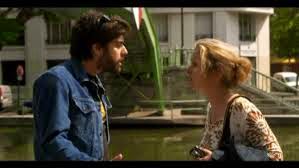
Marion and Jack fighting near the Seine.